The Hidden Pipes of American Finance: How Plaid Conquered US Banking
A deep technical exploration of ACH rails, Fedwire, screen scraping wars, and the API layer that now powers 1 in 2 Americans' financial lives.
Every time you link your bank account to Venmo, split a bill on Splitwise, or check your net worth on Mint, something extraordinary happens beneath the surface. In milliseconds, a complex dance unfolds between legacy mainframes running COBOL code from the 1970s, modern cloud APIs, and a single company that has quietly become the connective tissue of American finance: Plaid. With over 12,000 financial institutions connected and nearly half of all US adults having used a Plaid-powered application, this San Francisco startup has achieved what seemed impossible—it made the Byzantine US banking system feel simple. But how? Buckle up. We're about to trace the data packets that power your financial life.
The Chaos Before the Calm: Understanding US Banking Infrastructure
Before we dissect Plaid, we must first understand the madness it tames. Unlike countries with centralized payment systems (India's UPI, UK's Faster Payments), the United States operates on a patchwork of overlapping, competing, and often incompatible payment rails. This isn't a bug—it's a feature of American federalism and the 150-year evolution of its banking system. At the foundation, you have roughly 4,500 commercial banks and 5,000 credit unions. Each operates its own core banking system—the software that maintains the ledger of who owns what. These systems range from modern cloud-native platforms to IBM AS/400 machines that predate the internet. Connecting them? A handful of payment rails, each with different speeds, costs, and use cases.
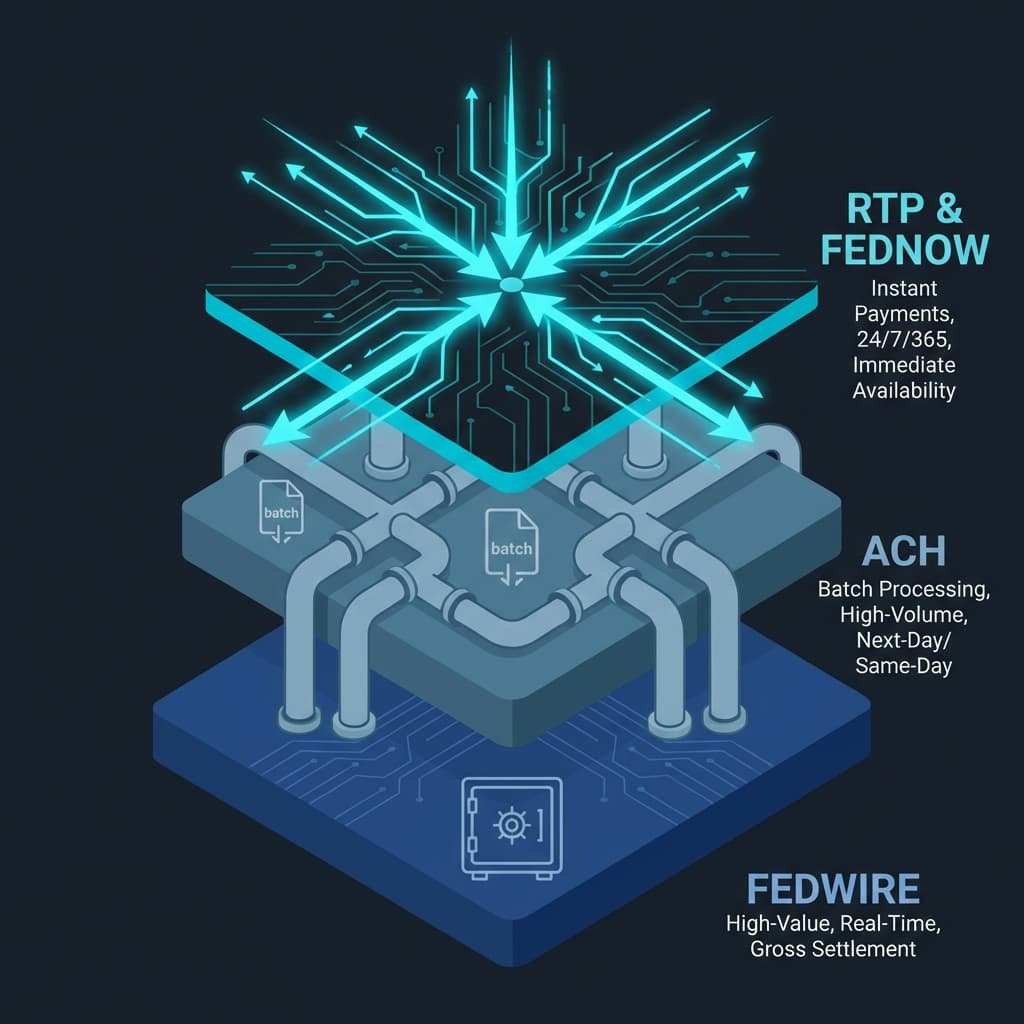
- 1ACH (Automated Clearing House)The workhorse of American payments. Processes 30+ billion transactions annually—payroll, bills, transfers. Batch-processed, typically 1-3 business days. Operated by The Clearing House and the Federal Reserve's FedACH.
- 2FedwireThe heavy artillery. Real-time gross settlement for high-value transfers (average $5.8 million per transaction). Used for interbank settlements, securities, and urgent corporate payments. Processes $4+ trillion daily.
- 3RTP (Real-Time Payments)The Clearing House's answer to instant payments. 24/7/365 settlement in seconds. Growing fast but limited to participating banks (~65% coverage).
- 4FedNowThe Federal Reserve's instant payment system launched in 2023. Designed to democratize real-time payments for smaller banks. Still building adoption.
- 5Card NetworksVisa, Mastercard, Amex, Discover. Separate rails entirely, with their own clearing and settlement mechanisms. Faster for consumers but expensive for merchants (2-3% fees).
The Data Problem: Why Banks Don't Talk to Apps
Here's the dirty secret of American banking: moving money is hard, but moving *data* is harder. When you open your Chase app, you see your transactions beautifully formatted. But that data lives in Chase's proprietary systems. There's no universal API, no standard format, no 'data portability' mandate (until the CFPB's Section 1033 rule, still being implemented). For decades, if a fintech wanted your bank data, they had two options: **Option 1: Beg the bank for an API.** This required enterprise sales cycles, legal negotiations, and custom integrations. A startup building a budgeting app couldn't afford this. **Option 2: Screen scraping.** Give us your username and password. We'll log in as you, download the HTML of your account page, and parse it for data. Yes, really. The financial technology revolution was built on the digital equivalent of copy-pasting from a webpage. It was fragile (banks changed their UI, scrapers broke), insecure (credentials stored by third parties), and lived in a legal gray zone. But it worked. And it's how Plaid started.
The Evolution of Bank Data Access
Enter Plaid: The Great Unifier
Founded in 2013 by Zach Perret and William Hockey, Plaid started as a budgeting app before pivoting to solve the infrastructure problem they kept hitting: connecting to banks was a nightmare. Their insight was simple but profound—instead of every fintech building scrapers for every bank, build ONE platform that handles ALL the connections, then let apps plug in via a single, clean API. Plaid became the translation layer between the chaos of banking backends and the simplicity fintech apps needed. One integration with Plaid = access to 12,000+ financial institutions. For startups, this was rocket fuel. For banks, it was... complicated.
Plaid's Technical Architecture: The Five Layers
Plaid's system is a masterpiece of abstraction. Let's peel back the layers:
- 1Layer 1: Plaid Link (Frontend SDK)The drop-in UI component that apps embed. Handles bank search, credential input, OAuth redirects, MFA challenges. Available for web, iOS, Android, and React Native. This is what users see.
- 2Layer 2: Connection EngineThe intelligence layer that determines HOW to connect to each institution. OAuth? Screen scraping? Direct API? Plaid maintains connection status, handles retries, and routes to the optimal path.
- 3Layer 3: Data NormalizationRaw bank data is messy—different date formats, transaction codes, account types. Plaid normalizes everything into a consistent schema. 'CHECKCARD 1234 AMZN*MKTP' becomes 'Amazon' with category 'Shopping'.
- 4Layer 4: Product APIsThe actual endpoints developers use: /auth (account numbers for ACH), /transactions (spending history), /identity (KYC data), /balance (real-time balances), /liabilities (loans, credit cards), /investments (brokerage data).
- 5Layer 5: Webhooks & MonitoringReal-time notifications when data changes, connections break, or transactions post. Critical for apps that need to react instantly to financial events.
Plaid's Internal Architecture
The Authentication Dance: What Happens When You Click 'Connect Bank'
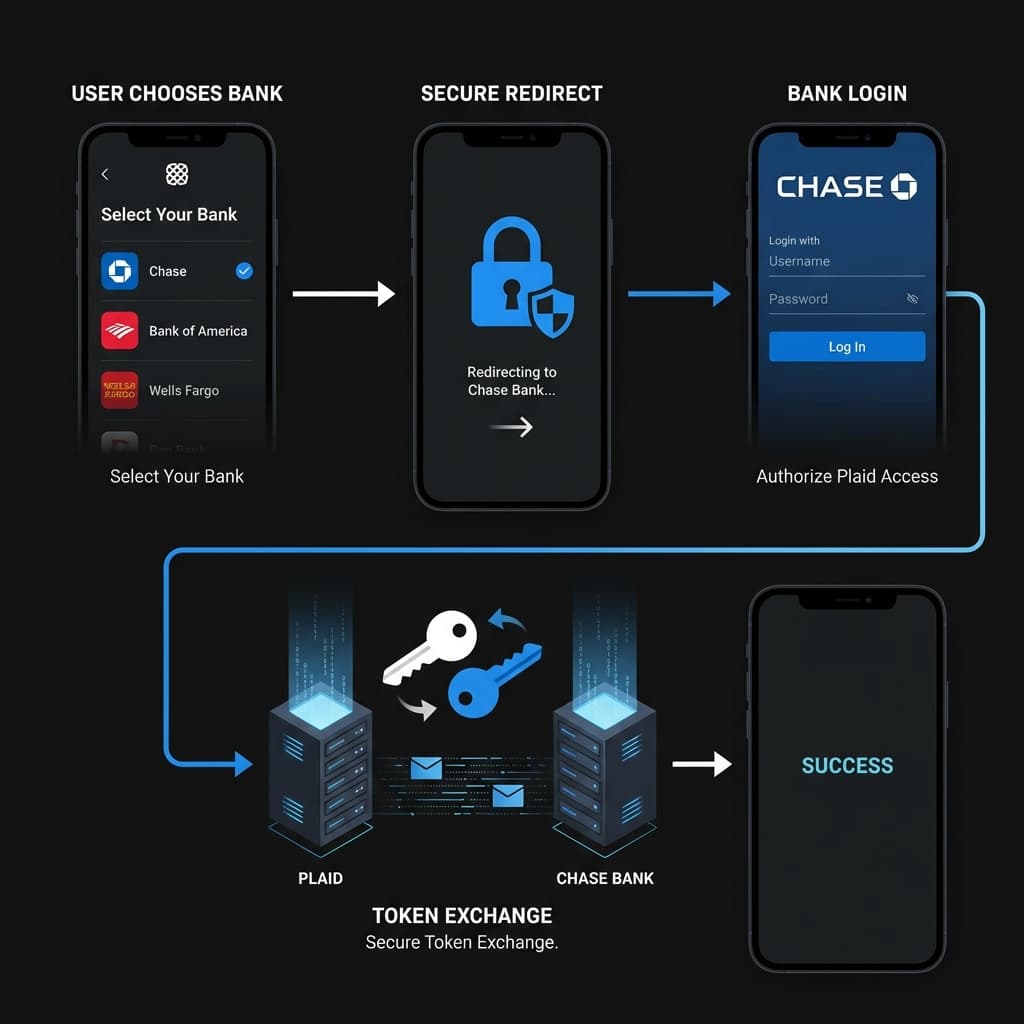
Let's trace a real connection flow. You're signing up for a new investment app and need to link your checking account. **Step 1: Link Token Creation** The app's backend calls Plaid's /link/token/create endpoint, specifying which products it needs (transactions, auth) and your user ID. Plaid returns a short-lived link_token. **Step 2: Link Initialization** The frontend loads Plaid Link with this token. You see a polished UI with a search bar. **Step 3: Institution Selection** You type 'Chase'. Plaid's search returns Chase Bank. Behind the scenes, Plaid knows Chase supports OAuth—no credentials will touch the fintech's servers. **Step 4: OAuth Redirect** You're redirected to Chase's official login page. You authenticate with your Chase credentials and approve data sharing. Chase issues an authorization code to Plaid. **Step 5: Token Exchange** Plaid exchanges the auth code for an access token. This token is stored securely and used for all future API calls. Your credentials? Never touched by Plaid or the fintech. **Step 6: Public Token to Access Token** Plaid Link returns a public_token to the frontend. The frontend sends this to the app's backend, which exchanges it for a permanent access_token via /item/public_token/exchange. **Step 7: Data Retrieval** The app can now call /transactions/get or /auth/get using the access_token. Data flows. Magic happens.
The Screen Scraping Wars: Banks Fight Back
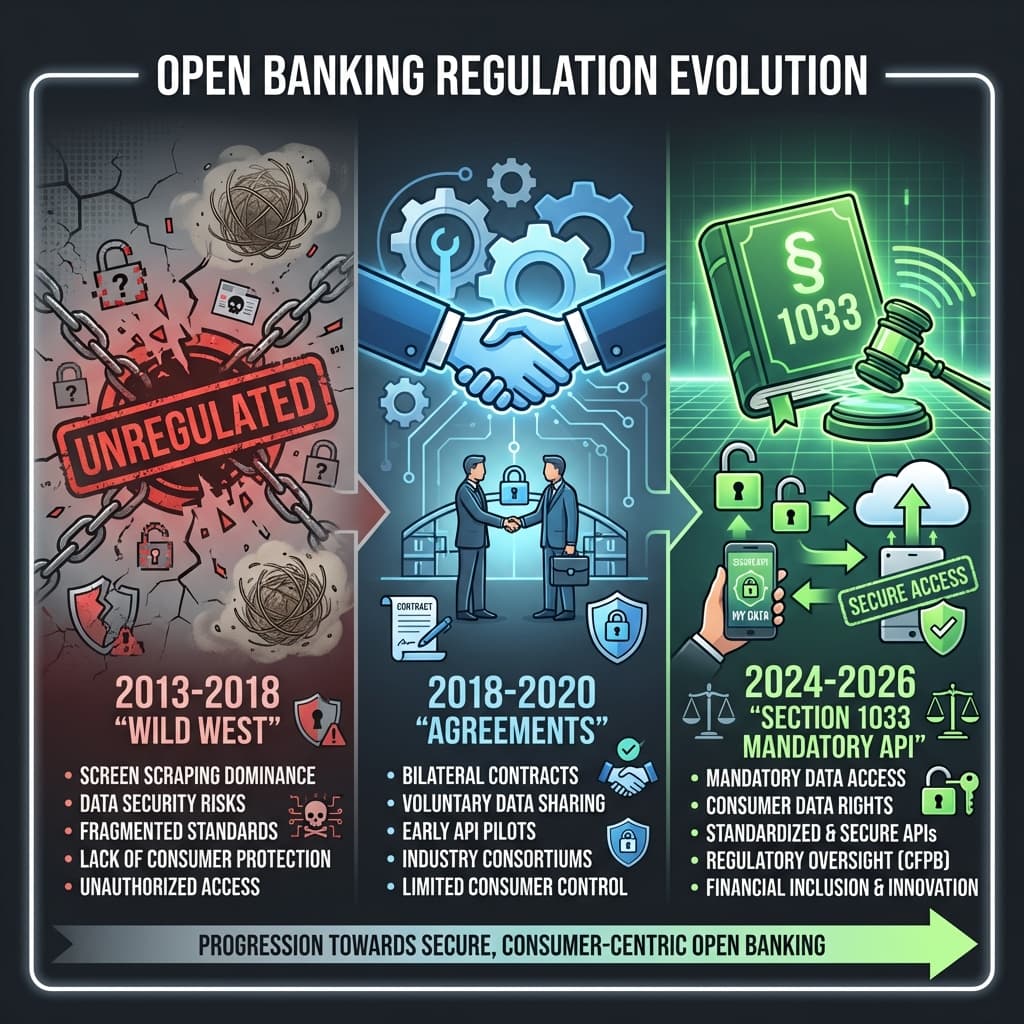
Plaid's early success came from screen scraping—and banks hated it. From their perspective, third parties were logging into customer accounts, creating security risks and liability nightmares. Major banks like Capital One, JPMorgan, and Wells Fargo actively blocked scrapers, playing cat-and-mouse with aggregators. The turning point came in 2018-2020 when banks realized they couldn't stop the tide. Consumer demand for fintech apps was too strong. Instead of blocking, banks started signing data-sharing agreements: • **2018**: JPMorgan Chase partners with Plaid, Finicity, and others • **2019**: Wells Fargo signs API agreement with Plaid • **2020**: Capital One, US Bank, and others follow These agreements moved connections from scraping to OAuth-based APIs. Better security. Better reliability. Better data quality. But there's a catch—banks can now control what data flows. Some provide 90 days of transactions via API vs. 24 months via scraping. The power dynamic shifted.
The CFPB's Section 1033: Regulation Enters the Chat
In October 2024, the Consumer Financial Protection Bureau finalized its Section 1033 rule—America's first comprehensive open banking regulation. The rule mandates that banks must provide consumers access to their financial data in a standardized, machine-readable format. Key provisions: • Banks must make data available via developer interfaces (APIs) • No fees can be charged for data access • Third parties must limit data use to what consumers authorize • Large banks must comply by April 2026; smaller institutions get more time This regulation legitimizes what Plaid has been doing for a decade. It also creates new competition—banks can now build their own data-sharing portals, and competitors like MX, Finicity, and Akoya are racing to capture market share. Plaid's moat? Its 12,000+ connections and the institutional knowledge of how each bank's systems actually work.
Beyond Data: Plaid's Expansion into Payments
Plaid isn't just about reading data anymore. With products like Plaid Transfer, they're enabling apps to move money—not just view it. **Plaid Transfer** leverages the auth data Plaid already has (account and routing numbers) to initiate ACH payments. Instead of building ACH infrastructure yourself, you call Plaid's API. They handle: • Return risk assessment (using their proprietary Signal product) • Same-day ACH processing • Ledger management • Compliance and reporting This is the holy grail—a single integration for both data AND payments. The company that owns the connection layer is now owning the transaction layer. Stripe, Square, and traditional processors should be nervous.
Plaid Transfer: The Payment Flow
The Numbers: Plaid by the Data
Let's talk scale: • **12,000+** financial institutions connected • **8,000+** fintech apps powered by Plaid • **~50%** of US adults have used a Plaid-powered app • **$13.4 billion** valuation (as of 2021 funding round) • **Billions** of API calls processed monthly The company processes more financial data connections than any other player in the US market. When Visa tried to acquire Plaid for $5.3 billion in 2020, the DOJ blocked it on antitrust grounds—a testament to Plaid's market power.
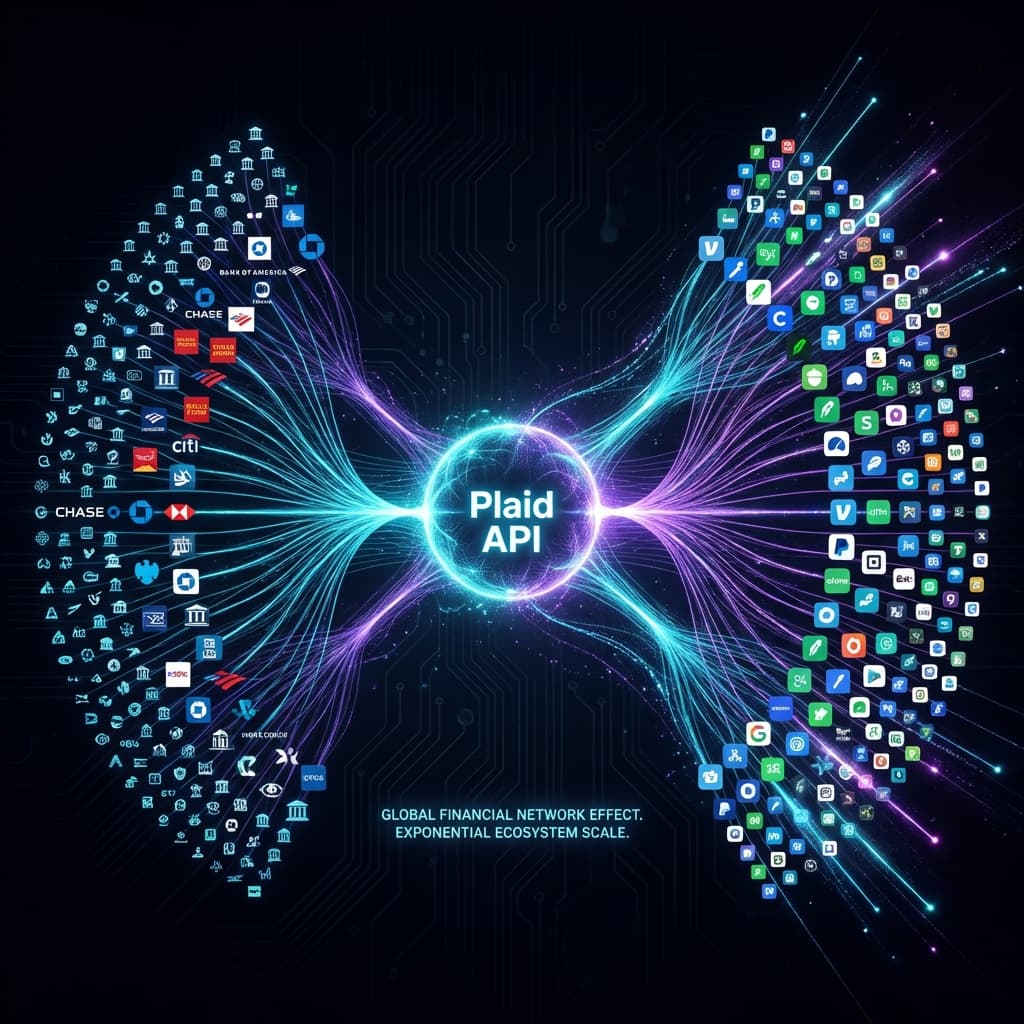
Visualizing the Flow: Inside Plaid's Network
PROMPT used for generation:
Create a 90-second cinematic visualization of financial data flowing through Plaid's network. Start with millions of glowing smartphone screens across a map of the United States. Data packets (represented as light particles) stream upward from phones into regional clouds representing different banks (show logos: Chase, Wells Fargo, Bank of America fading in). These streams converge into a massive central hub (Plaid's infrastructure) visualized as a crystalline data center. Inside, show the data being transformed—messy raw packets becoming clean, organized streams. The processed data then fans out to thousands of app icons (Venmo, Robinhood, Coinbase, etc.). End with a single user checking their balance on their phone, the data journey completing in under 2 seconds. Style: Blade Runner meets Minority Report. Deep blues, electric purples, data streams as light trails. Epic orchestral soundtrack.Security: How Plaid Protects Your Data
Given that Plaid handles the most sensitive financial data imaginable, security is existential. Their approach: **Encryption Everywhere** AES-256 encryption for data at rest. TLS 1.2+ for data in transit. Even within their internal network, data is encrypted between services. **Tokenization** Your bank credentials (when used) are never stored in raw form. Access tokens replace passwords. Even if Plaid's database was breached, attackers couldn't log into your bank. **SOC 2 Type II Compliance** Annual audits verify their security controls meet rigorous standards. Banks require this before signing data-sharing agreements. **Minimal Data Retention** Plaid only stores what's necessary. Under OAuth agreements, they often don't store credentials at all—the bank handles authentication directly. **Consumer Control** Through Plaid Portal (my.plaid.com), users can see every app connected to their accounts and revoke access instantly.
The Competition Heats Up
Plaid isn't alone anymore. The market for financial data aggregation is exploding: **MX** - Focuses heavily on data enrichment and financial wellness insights. Strong in credit unions. **Finicity** (Mastercard) - Acquired by Mastercard, strong in mortgage verification and lending use cases. **Akoya** - Bank-owned consortium (including JPMorgan, Wells Fargo) building a competitor. The banks want control back. **Yodlee** (Envestnet) - The original aggregator, now pivoting to wealth management analytics. **Direct Bank APIs** - Major banks are building their own developer portals. Chase, Capital One, and others now offer APIs directly to approved partners. Plaid's advantage? Network effects and developer experience. They've spent a decade making their API delightful to use. Switching costs are high when your app is built on Plaid's data models.
What This Means for the Future of Finance
Plaid represents something bigger than a company—it's a thesis about how financial services will work. The future isn't one mega-bank that does everything. It's specialized apps (savings, investing, lending, payments) connected via data plumbing to your existing accounts. This 'embedded finance' future requires infrastructure players like Plaid. Every neobank, every 'pay later' service, every payroll app needs bank connectivity. As more financial experiences become software-first, the API layer becomes the new battleground. The winners won't just move money—they'll understand it. The data flowing through Plaid's pipes (transaction patterns, income, spending habits) is a goldmine for building AI-powered financial products. Who has the best model for predicting loan defaults? Probably whoever has the most comprehensive view of consumer financial behavior. Plaid's ambition is clear: become the financial operating system that every app builds on. They're not just connecting banks anymore—they're building the rails for the next generation of money.
Final Thoughts: The Invisible Infrastructure
The best infrastructure is invisible. When you tap 'Connect Bank' and it just works, you don't think about the decades of legacy systems, the regulatory battles, the screen-scraping wars, or the OAuth token exchanges happening in milliseconds. That invisibility is Plaid's greatest achievement. They took the most fragmented, complex financial system in the developed world and made it feel like a single, unified API. For developers, it's a superpower. For consumers, it's the freedom to use any financial app without friction. As we enter the era of mandated open banking, AI-driven financial advice, and real-time payments becoming the norm, the companies that control the data layer will shape how money moves. Plaid bet on this future in 2013 when connecting to a bank meant storing passwords and parsing HTML. That bet is paying off. And for anyone building the next great fintech app, understanding how Plaid—and the banking infrastructure beneath it—actually works isn't just interesting. It's essential.